
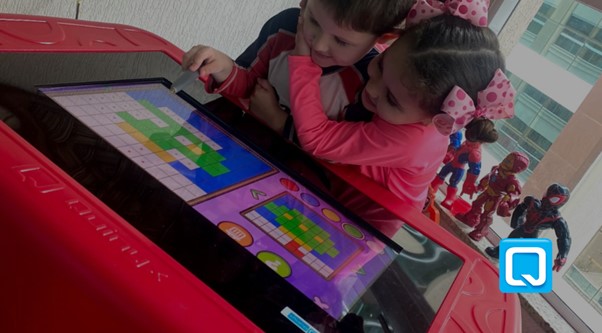
Digital tables are a powerful tool for encouraging joint play and social skills.
Although children interact more and more with screens, this does not mean that the activity should be individual. Using interactive features, a playful interface, and a pedagogical basis specially designed for young children, some digital tools help bring people together, whether in the classroom or within the family.
Quinyx provides educational technology products, and there are a number of options for this, such as games that allow for more than one player, with collaborative and group activities.
Tools such as Digital Tables offer options for children to play together, collaborate, and learn social skills such as teamwork and conflict resolution. They need to work together to achieve a common goal, which encourages cooperation and communication. The activities are enhanced by the space, as the equipment can be set up so that several children can sit around it, facilitating joint fun.
In this context, in addition to assisting and complementing the work of teachers in the classroom, it is believed that they can also be used by families to promote greater interaction between siblings who play and study with screens.

They can put together puzzles, answer questions, or explore concepts together, based on a habit that is already familiar to them, such as using screens. These tools are designed to promote meaningful interactions between children and balance the use of technology with valuable opportunities for socialization, collaboration, and learning. This strengthens communication between siblings and creates positive memories between them.
Resources and custom development
There are already a number of apps that can be used by more than one child at the same time, such as HistorIA, Labirinto de Comandos, Movimente-se, and Letrix. But to enable this interaction, the table needs to have certain features, such as multiple touch points and the ability to recognize touches from several fingers at the same time.
It is also worth noting that the scenario designed for interaction promotes inclusion, which is still a challenge in Brazil. Among the approximately 17.3 million people with disabilities (PWDs) in the country, almost 70% have not completed elementary school and only 5% have finished college. The data are from the 2019 National Health Survey conducted by the Brazilian Institute of Geography and Statistics (IBGE).
As technology can be a key ally in this process, facilitating accessibility and integration for students, tools such as mMesinha Digital can also be equipped with features such as screen readers, which convert text to speech, text and image magnifiers, sign language translators, subtitles, and transcripts so that deaf students can also participate.
This whole set of space and collective learning and fun prepares children for the future. We are talking about social skills such as communication, teamwork, and conflict resolution through critical thinking and creativity. In this supportive and mutually helpful environment, we build positive relationships and friendships, enriching cognitive and emotional development.
Although constant supervision is not necessary, the presence of responsible adults is important to promote healthy and safe interaction among children, at least in the early stages of interaction. Their role, in this case, is that of mediator, to ensure that children are behaving appropriately and respectfully toward one another, and to intervene if necessary.